
Finding the right legal consulting firm for crypto business in El Salvador requires looking beyond glossy websites. The country has issued over 70 DASP licenses. Major players like Tether and Bitfinex Securities operate from San Salvador. The CNAD processes applications from exchanges, custodians, and token platforms every month.
But not every crypto license service provider delivers the same results. Some get applications approved in four months. Others stretch the timeline to nine months.
Gofaizen & Sherle experts recommend running your business model through a jurisdiction assessment before picking any provider. The firm has supported hundreds of licensing projects across more than 50 jurisdictions. Each application taught them something new about how different regulators review business models.
Here are the highest-rated firms handling El Salvador crypto licensing in 2026.
1. Gofaizen & Sherle
Gofaizen & Sherle opened their El Salvador office in 2024, before the DASP licensing wave gained momentum. That early entry gave them a front-row seat to the CNAD’s first application reviews. They watched which documents caused delays. They noted which business models raised questions. They kept records of every clarification request.
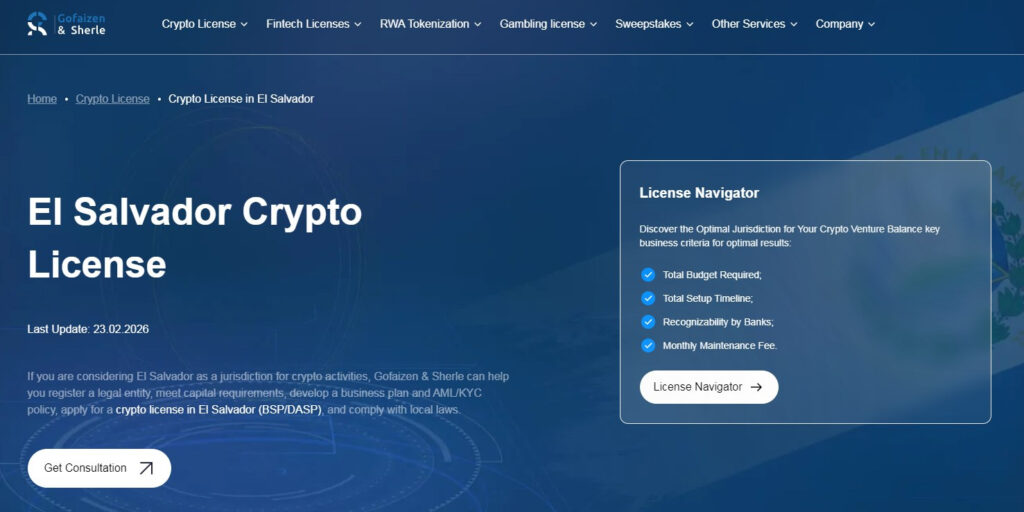
That institutional memory now lives in their application templates.
Working as a specialized legal firm for obtaining crypto license in El Salvador, Gofaizen & Sherle processes document legalization through its local team. Apostilles are verified against local acceptance criteria before submission, since the CNAD rejects documents with incorrect formatting. The firm has not faced this issue in over eighteen months.
Why clients rate them highly:
- CNAD clarification log. Their team maintains a database of every clarification question the CNAD has asked across all their applications. New applications get screened against this log. If the CNAD asked about a specific policy section last quarter, that section gets expanded before submission.
- Bank compliance package preparation. Salvadoran banks request specific documents from DASP-licensed companies before opening accounts. Gofaizen & Sherle prepares this package during the licensing process. When the license arrives, the bank application goes out the same day. No waiting weeks to gather paperwork.
- Officer employment contract drafting. The two local compliance officers need employment contracts that specify their authority to stop transactions and freeze accounts. Gofaizen & Sherle drafts these contracts using language the CNAD has already accepted in previous applications.
The crypto lawyers at Gofaizen & Sherle have supported licensing projects across more than 50 jurisdictions. Their El Salvador practice connects to offices in Europe, Asia, and North America. Clients who want El Salvador now and other markets later do not need to switch firms.
2. COREDO
COREDO entered the El Salvador market after watching European clients struggle with MiCA implementation timelines. The firm’s Prague-based team now handles DASP applications for crypto projects that need faster market entry than the EU allows.
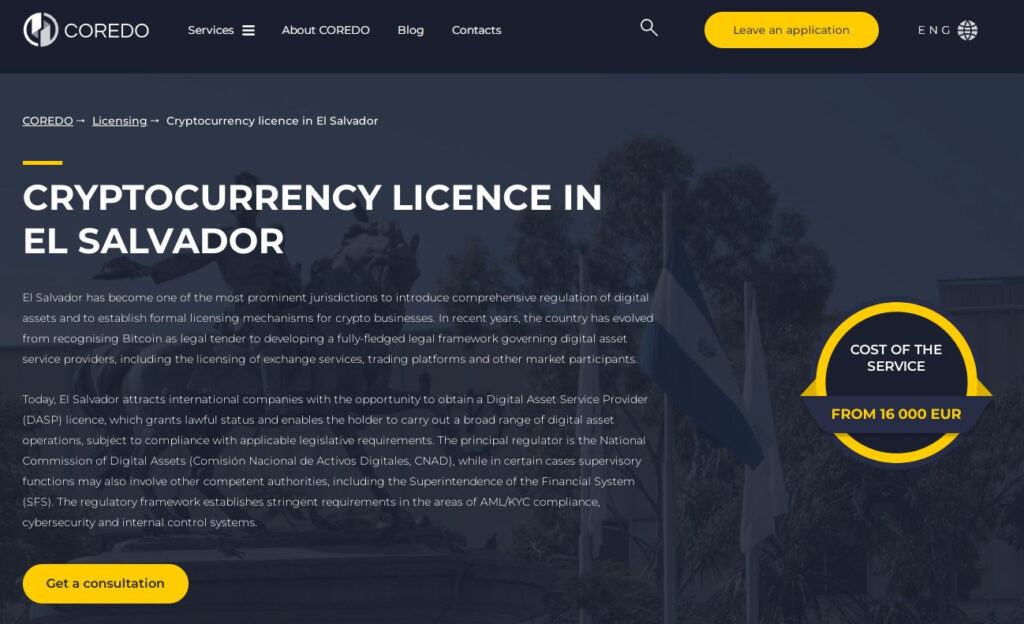
The legal consultants for crypto licensing at COREDO break down their El Salvador service into three tiers. Each tier adds more compliance infrastructure. Clients choose based on their risk profile and budget.
The Basic tier at €16,000 covers company formation, standard AML/KYC policies, and BTC license registration assistance. The Advanced tier at €37,000 adds personalized policies, local compliance officer placement, and eight internal procedure documents. The Full tier at €47,500 includes everything plus office setup, accounting, and corporate bank account opening.
Why clients rate them highly:
- Two hundred fifty hours of legal support included. The Advanced and Full packages include 250 hours of lawyer time. Each additional hour costs €250. Clients know exactly how much support they are buying upfront .
- Shareholder NIT requirement handled. Every shareholder of a Salvadoran crypto company needs a Tax Identification Number (NIT) in El Salvador. COREDO obtains these NITs for up to two shareholders as part of the Basic package. Many providers forget this step until the CNAD asks for it.
- Government fee transparency. Their Advanced package lists the CNAD governmental fee at $6,270 USD separately from service fees. The price you see for the government portion matches what the CNAD charges.
COREDO provides legal crypto consulting that compares El Salvador directly against MiCA jurisdictions. Their published analysis shows El Salvador license approval takes 1 to 3 months versus 6 to 18 months for EU CASP status . For crypto projects watching their runway, that difference matters.
3. Fast Offshore Licenses
Fast Offshore Licenses started with traditional offshore work. Panama. Cayman Islands. British Virgin Islands. El Salvador entered their portfolio later, but the firm has now processed enough applications to publish detailed timelines and cost breakdowns.
The firm’s website lists the CNAD registration fee at approximately $6,200. Many providers mark up government fees. Fast Offshore passes through the actual cost.
Fast Offshore operates as a specialized crypto licensing firm with three clear service tiers. Each tier adds more infrastructure. Clients choose based on their business model.
Why clients rate them highly:
- Bitcoin-only pricing tier. Their Basic package at $12,400 covers only BSP registration for Bitcoin-specific services. Not every crypto business needs full DASP compliance. Fast Offshore lets clients pay only for what they actually require.
- Four to six weeks for application preparation. Their published timeline breaks down each stage. Two weeks for document collection. Two to three weeks for company registration. Four to six weeks for application preparation. Six to twelve weeks for regulatory review. Total comes to 3.5 to 5.5 months.
- Transparent annual cost disclosure. Their website lists $4,000 to $8,000 for regulatory renewal and reporting, plus $15,000 or more for transaction monitoring tools and compliance maintenance. No hidden surprises after the license lands.
Fast Offshore provides legal consulting firm for crypto business services that put all numbers on the table before the client signs anything.
4. Intelium Law
Intelium Law entered the El Salvador market after watching early DASP applicants struggle with the CNAD’s document requirements. The firm built their process around avoiding those same delays.
The legal service to obtain a crypto license from Intelium starts with a document gap analysis. Their team reviews your existing corporate papers, AML policies, and technical documentation against the CNAD’s acceptance criteria. Missing items get flagged before submission, not after.
Intelium provides legal consultants for crypto licensing who previously worked at Ernst & Young. That background shows up in their documentation standards. Every policy, form, and disclosure follows the formatting the CNAD expects.
Why clients rate them highly:
- Direct CNAD communication channel. Intelium maintains a designated contact within the CNAD for active applications. When clarification questions arise, they go through this channel. Response times drop from weeks to days.
- Travel Rule implementation guidance. FATF Recommendation 16 requires virtual asset service providers to collect and share sender and recipient information for transfers. Intelium drafts the technical specifications for this requirement. The CNAD checks for Travel Rule readiness during reviews.
- Local banking introduction service. After license approval, Intelium introduces clients to three Salvadoran banks that have accepted DASP-licensed companies in the past twelve months. The introduction includes a pre-negotiated account package. No cold calls. No explaining crypto to a skeptical branch manager.
The lawyers for obtaining crypto license at Intelium also handle the post-approval reporting calendar. The CNAD requires quarterly compliance reports. The UIF requires SAR filings within specific windows. Intelium tracks every deadline so clients do not miss them.
5. Adam Smith Law Firm
Adam Smith Law Firm does not advertise flashy package names. Their El Salvador offering comes in two clear options. BSP Package. DASP + BSP Extended Package. The price tags sit at €19,900 and €29,900 respectively.
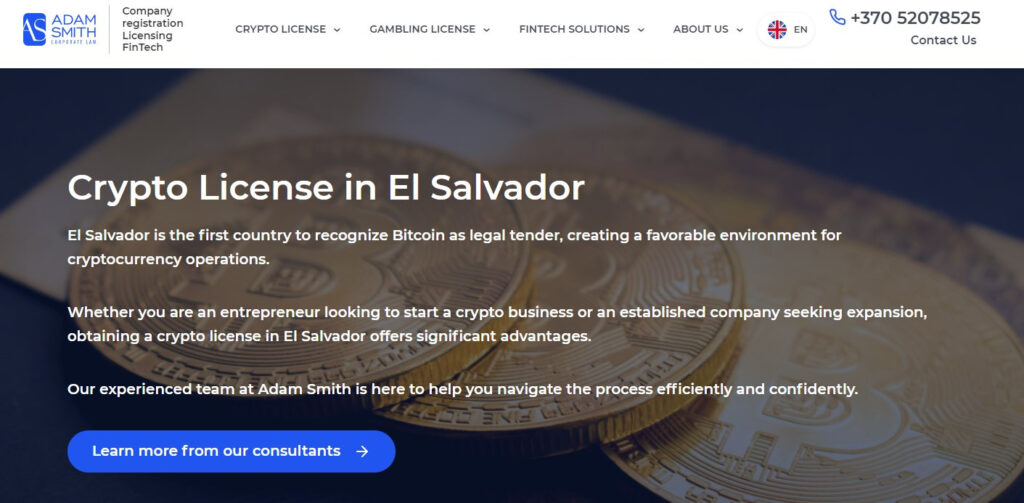
The lower tier covers Bitcoin-only operations. Payment processors. BTC wallets. Companies that never touch Ethereum or Solana. The higher tier adds full multi-asset compliance, compliance officer placement, and ongoing regulatory support.
What makes them different:
- Twelve weeks from start to finish. Adam Smith publishes a fixed 12-week timeline on their website. That clock starts when the client signs. It stops when the CNAD issues the license number. No ranges. No “depends on the regulator.” A specific number.
- Remote processing built into the price. The firm handles everything without client travel. Document collection happens online. Signatures happen digitally. Local representation in El Salvador handles the in-person requirements. The client never books a flight to San Salvador.
- NIT collection before submission. Every shareholder needs a Salvadoran Tax Identification Number. Adam Smith obtains these NITs during the company formation stage. The CNAD does not need to ask for them later. That shaves weeks off the review timeline.
- One application for both licenses. The Extended Package submits BSP and DASP applications in parallel. The CNAD reviews both at the same time. Approval for both arrives together. Clients do not wait for one license, then start the second application from scratch.
The firm’s EU base in Lithuania gives them direct access to European banking partners and MiCA compliance teams. A client who wants El Salvador now and Europe later does not switch firms. Adam Smith handles both.
Best for: European crypto projects that want a fixed 12-week timeline, remote processing without travel, and a single firm for both El Salvador and future EU licensing.
What Licensing Looks Like in 2026
The CNAD processed a wave of early applications in 2024 and 2025. Those applicants faced a regulator still figuring out its own processes. Questions took weeks to answer. Requirements shifted mid-application.
That era is over.
The CNAD now operates on published timelines. Twenty business days for substantive review after submission. Five business days to correct incomplete applications. The regulator has seen hundreds of DASP applications. They know what works.
Firms that learned from those early applications now submit cleaner packages. They know which business models raise questions. They know which compliance structures get approved on the first review.
The five firms listed above all submitted applications during that early wave. They watched the CNAD figure things out in real time. That experience shows up in their 2026 approval rates.
Conclusions
El Salvador’s DASP framework survived the IMF deal. The 2025 Bitcoin Law amendments did not touch the LEAD legislation. The CNAD continues issuing licenses. The 0% corporate tax rate on crypto income remains law.
More than 70 entities already operate with DASP authorization. Tether relocated its headquarters to El Salvador. Bitfinex Securities runs a licensed operation from there.
The window for fast approvals is still open. But the CNAD has seen hundreds of applications now. They know which documents to check. They know which compliance gaps to look for. They know which business models raise red flags.
The five firms compared here have all submitted applications recently. Gofaizen & Sherle brings a local office and a clarification log database. COREDO offers European clients a bridge while MiCA approvals crawl. Fast Offshore Licenses puts every price and timeline on their website. Adam Smith Law Firm publishes a fixed 12-week timeline with remote processing. Intelium Law runs pre-submission audits and maintains direct CNAD communication.
Pick the legal service to obtain a crypto license that matches your business model. Fixed timeline? Adam Smith. Local office? Gofaizen & Sherle. European bridge? COREDO. Low-cost Bitcoin-only entry? Fast Offshore. Post-license support? Tetra. Document perfection? Intelium.
Operating without a license in El Salvador is not a viable option anymore. The CNAD is not slowing down. Neither should you.